304 vs 316 Stainless Steel Pipe: Choose by Failure Mode
Why Most 304 vs 316 Decisions Go Wrong
Choose wrong in one direction and you pay a modest premium on every meter of pipe. Choose wrong in the other direction and you replace a pipeline, stop a plant, or explain a contamination incident to a customer. This guide works from that asymmetry: identify the failure mode first, then pick the grade.
The Only Three Questions That Decide the Grade
Chloride is the main trigger for pitting and crevice corrosion on austenitic stainless steel. Molybdenum in 316 raises the tolerance significantly; 304 has almost no margin in warm chloride service.
Both grades weld well, but 316 in welded process piping is often specified as 316L to control sensitization. If pickling and passivation cannot be done after welding, grade choice becomes more conservative.
If a failure means a two-day maintenance window, 304 economics may win. If a failure means a shutdown, a safety incident or a rejected product batch, the material premium becomes trivial next to the exposure.
If you cannot answer all three, the specification is not ready for quotation — and no supplier can honestly price it for you.
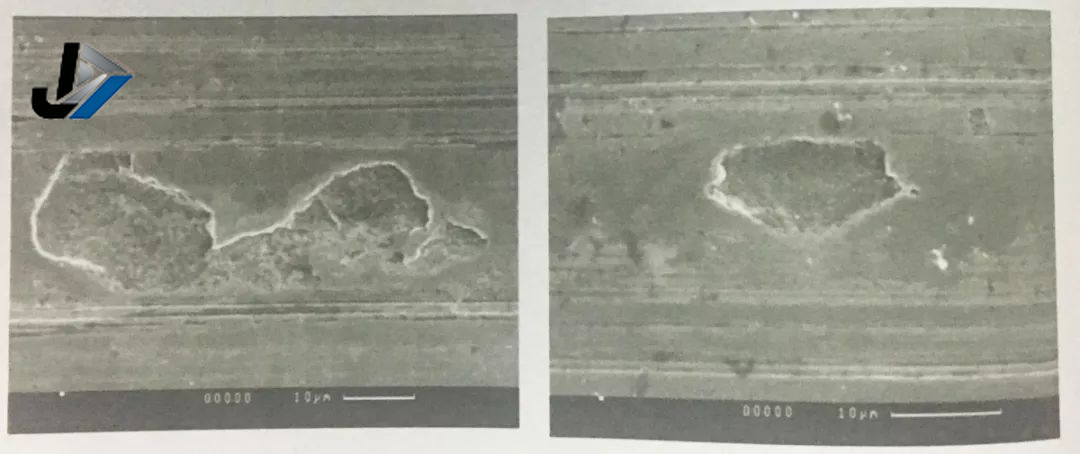
Corrosion failure sample
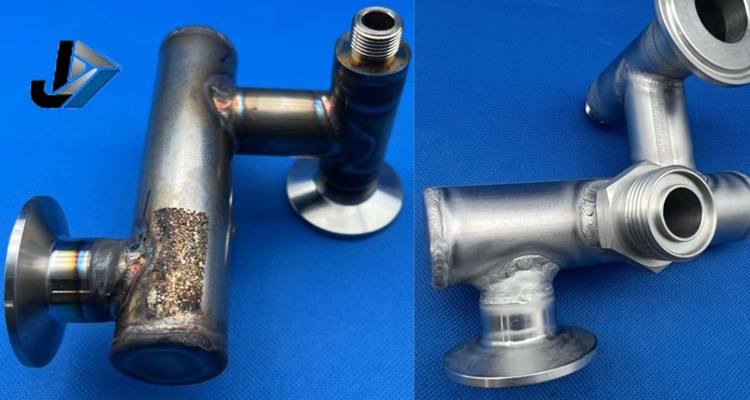
Comparison of weld surface before and after acid pickling and passivation
Chloride and Temperature: The Practical Boundary
Two practical notes. First, temperature matters more than most buyers expect: a medium that 304 tolerates at 25 °C can become aggressive at 60 °C. Second, crevice conditions are usually more dangerous than the bulk chemistry, because the local environment inside a crevice becomes acidic and oxygen-depleted.
Composition Difference, Stated Without the Textbook
* 304 (UNS S30400 / 1.4301) — roughly 18% chromium and 8% nickel, no molybdenum. Excellent general corrosion resistance in oxidizing and mildly corrosive media, very good deep drawing and bending behavior.
* 316 (UNS S31600 / 1.4401) — chromium slightly lower, nickel higher, plus about 2–3% molybdenum. The molybdenum is what improves resistance to pitting and crevice corrosion in chloride environments.
Everything else — formability, hygiene suitability, non-magnetic austenitic structure, cryogenic toughness — is broadly similar. If a supplier quotes 316 as "much stronger than 304", ask for the design basis: the allowable stress difference is modest and rarely the deciding factor.
Fabrication Realities That Change the Real Cost
Total Cost Comparison: A Simple Way to Argue the Decision
A useful sentence for your internal file: "304 was selected because chloride was below X ppm, temperature below Y °C, and the line is inspectable without shutdown." That single line protects you in an audit.
When Neither 304 Nor 316 Is the Answer
Conclusion: Choose by Exposure, Not by Habit
If you want a second opinion on a specification, send us the service conditions and the size list. We will tell you honestly whether 316 is justified — including when it is not.
Call to Action
? WhatsApp / WeChat: +86-190-3368-1875
? Factory visit, sample confirmation and third-party inspection are welcome.
Related articles:
Carbon Steel Pipe Solutions for Oil & Gas, Construction and Industrial Piping Projects
U-Type vs Z-Type Sheet Pile: Which to Choose for Your Projec
FAQ
316 contains about 2–3% molybdenum, which 304 lacks. That molybdenum improves resistance to pitting and crevice corrosion in chloride environments. Chemically, 304 is roughly 18% chromium and 8% nickel with no molybdenum, while 316 has slightly lower chromium, higher nickel and added molybdenum. In benign service the two grades perform similarly; in chloride service the difference is decisive.
304 is cheaper, typically by a noticeable margin per ton, and it is also more widely stocked. Standard 304 sizes usually ship from inventory, while 316 and especially 316L in less common diameters often require production scheduling. For straight pipe in ordinary service, 304 is the lower-cost option in both material price and lead time.
Choose 316 or 316L when chloride is present above low levels, when operating temperature is elevated, when crevices and stagnant zones exist, or when welded assemblies cannot be annealed after fabrication. Typical examples are coastal handrails, warm process water, bleach and brine handling, chemical and pharmaceutical piping, and seawater-adjacent equipment.
Only slightly, and rarely enough to change a design. Allowable stress values for 316 are marginally higher than 304 at common temperatures, so strength is usually not the deciding factor. If a supplier justifies 316 mainly as "much stronger," ask for the design basis. The real reason to specify 316 is corrosion behavior, not load capacity.
316L is the low-carbon version of 316. It is specified when the pipe or vessel will be welded and not annealed afterwards, because lower carbon reduces sensitization in the heat-affected zone. For welded process piping, tanks and hygienic lines, 316L is normally the safer specification. For unwelded machined parts, plain 316 is acceptable.
It can, but it is risky in coastal or de-icing-salt environments. 304 performs well in inland outdoor atmospheres, yet salt aerosol combined with crevices at mounting plates and welds can cause pitting within months. For seaside, bridge and high-salt sites, 316 is the usual choice; for inland projects, 304 with proper detailing is normally sufficient.
There is no single safe number. Published rules of thumb are only guides, because the real boundary moves with temperature, pH, flow velocity, oxygen and deposits. Warm water that 304 tolerates at ambient temperature can become aggressive well below boiling. Treat any fixed ppm figure as a starting point, then confirm against your actual medium, temperature and inspection access.
Welded 316/316L process piping normally requires proper filler metal, root-side inert gas protection, and pickling plus passivation of the weld zone. Skipping these steps can make a 316 line perform worse than a well-finished 304 line, because the weld and heat-affected zone lose local corrosion resistance. State the required post-weld treatment in the purchase order, not only in email correspondence.
304 is generally unsuitable for seawater and brine. 316L may be evaluated for cooler, controlled conditions, but duplex 2205 is often preferred because it offers higher strength and better resistance to stress corrosion cracking in chloride service. For high chloride combined with high temperature, evaluate 2205, 904L or nickel alloys rather than forcing a 304/316 comparison.
Yes, 304 is widely used in food, beverage and dairy lines where the medium is not chloride-aggressive. The specification that matters most is the internal surface: state the finish type and roughness limit, for example a defined grit polish or a maximum Ra value, together with the cleaning protocol. Upgrading to 316 does not compensate for an undefined surface finish.
Specify grade, standard, manufacturing method, OD and wall thickness, length and tolerance, quantity, surface finish and Ra requirement, end condition, service medium with chloride level and maximum temperature, whether the pipe will be welded by the buyer, and the certificates required. The two fields most often left blank — chloride level and post-weld treatment — are exactly the two that decide the grade.
Compare the material premium plus any extra fabrication cost against the replacement cost and the consequence of failure. If a leak means a short maintenance window in a benign service, 304 can be the defensible choice. If a leak means a plant shutdown, a safety incident or a rejected product batch, the 316 premium is small next to the exposure. Document the reasoning in your project file.
Message
Reach out via our contact form or use the details. We’re here to help!
LOGO